 PiR2-IT
Start an engagement
PiR2-IT
Start an engagement
An enterprise knowledge and document lifecycle platform for international organisations. Content is classified by network level up to RESTRICTED, every access is decided by attributes, an AI first reviewer scores each document, and people confirm, approve and sign. AI agents never hold administrative rights.
Each level lives on its own network domain with its own storage, index, knowledge graph, models and keys. A model carries the level of the data it was trained on and runs only there.
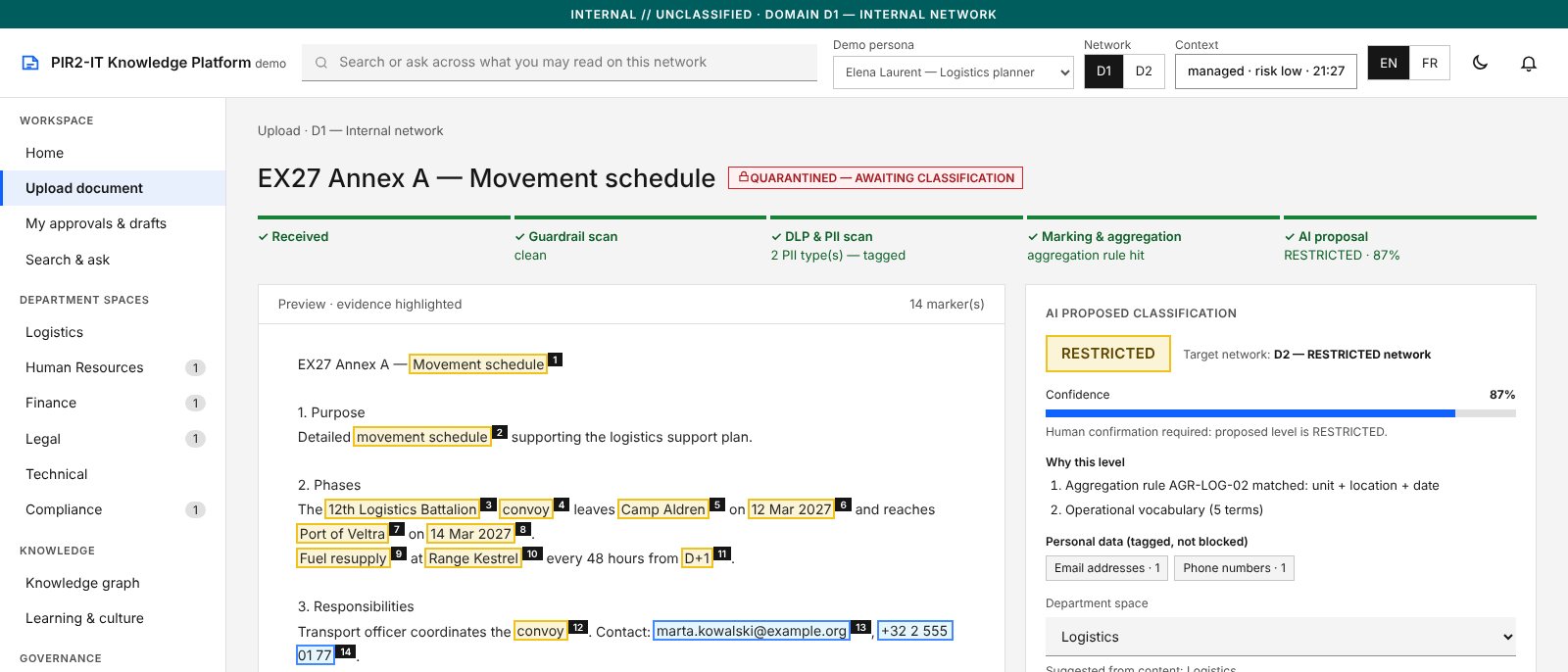
Markings, personal data, research vocabulary and aggregation rules propose a level with the evidence highlighted in the text. Humans confirm RESTRICTED, R&D and low-confidence cases.
Clearance, need-to-know, department, network and device decide every search, view, share and download in real time. Content you cannot read is never shown, counted or placed in an AI context.
A scorecard for tone, structure, template coverage and risk; side-by-side diff; 80% minimum and 85% fast-track thresholds; multi-level approval chain with justified overrides.
Prompt-injection patterns and hidden content are detected before any model sees the file.
Personal data is tagged as an access attribute and for redaction — not blocked.
Explicit markings and rules such as unit + location + date raise the level; anything above RESTRICTED is blocked.
The file stays in quarantine until the owner or Security Officer confirms the level.
The AI scores the document and proposes edits from glossary, template and risk rules.
Peer, department lead, Legal, Compliance and — for RESTRICTED — the Security Officer decide and sign.
The published version is sealed with SHA-256 and indexed only on its own network.
Review dates notify; lowering a level needs a signed approval and a cross-domain transfer.
The Knowledge Platform demo is a functional blueprint built on fictional people, units and documents; data stays in the visitor's browser. A production deployment is tailored to the organisation's classification policy, networks, identity provider and accreditation requirements.
No. The demo runs on fictional people, units and documents, and all data stays in the visitor's browser. It shows how the controls work; a production deployment for RESTRICTED runs on an accredited network with self-hosted models.
It is blocked at upload, before storage, indexing or any AI processing. A spillage incident is opened and the material follows the transfer procedure to a separately accredited Mission Critical System.
No. AI agents are non-human identities with a tool manifest. They propose a level and suggest edits; people confirm RESTRICTED, R&D and low-confidence classifications, approve, sign and publish. Administrative, approval and egress actions are blocked for every AI identity and logged.
Uploaded content is scanned before any model sees it. Instructions hidden in the content are flagged, neutralised and the file is isolated from AI processing until the Security Officer clears it. Classification itself is rules-based and cannot be steered by the content.
No. Review dates only notify the data owner. Lowering a level needs a request, an AI risk assessment that includes aggregation with documents already on the lower network, and a signed Security Officer approval through a cross-domain guard.
Every published version is sealed with a SHA-256 checksum. A change made outside the approval workflow is detected at the next check, the document is locked and an incident is opened. The audit log is append-only and hash-chained.
PiR2-ITIndependent consulting for institutions, regulated sectors and high-trust programmes.